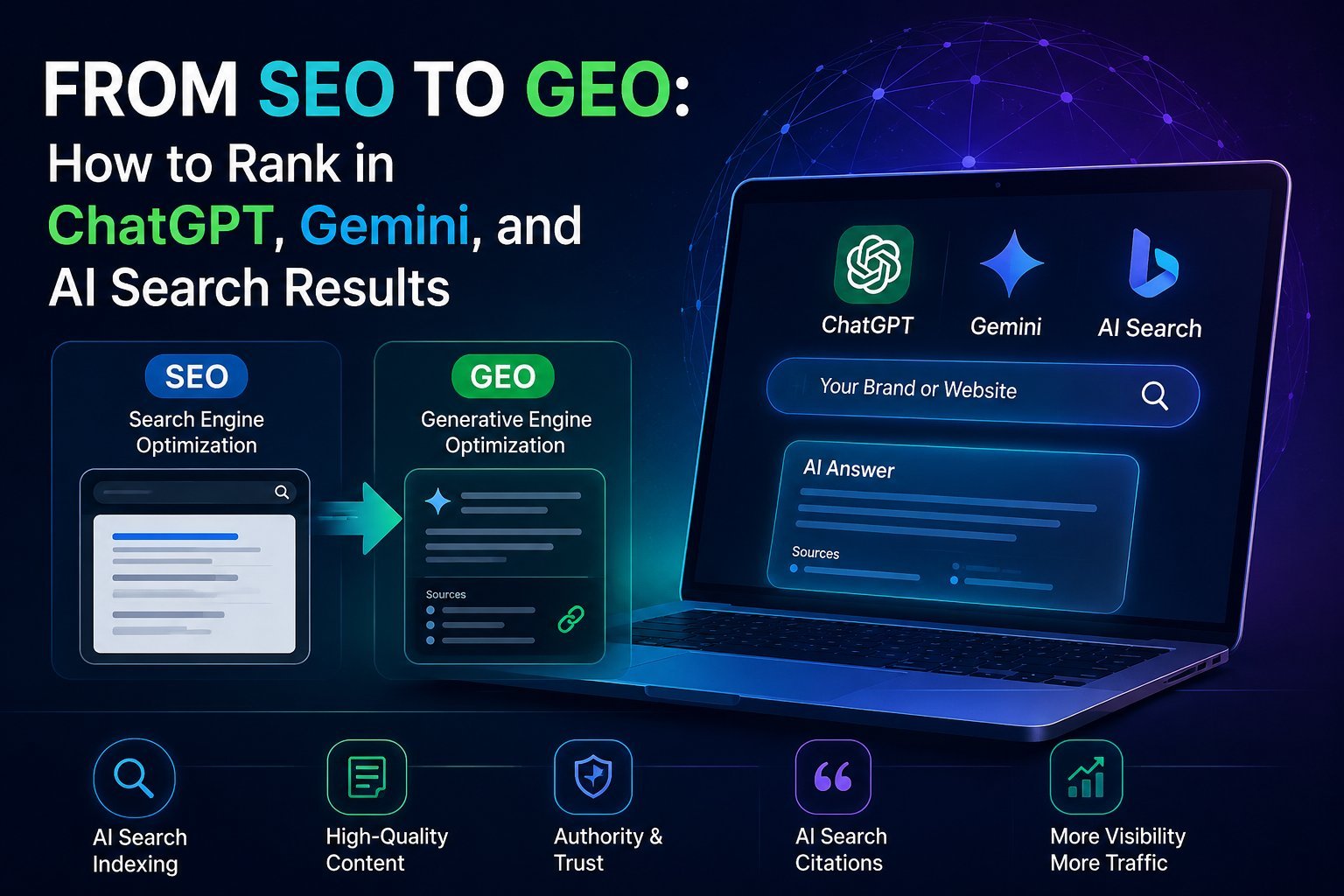
For years, businesses have relied on Search Engine Optimization (SEO) to improve their visibility on Google and other traditional search engines. Ranking on the first page of search results has been a primary goal for marketers, bloggers, and website owners. However, the rapid growth of AI-powered search platforms such as ChatGPT, Gemini, Perplexity, and Microsoft Copilot is transforming how people discover information online. Instead of presenting users with a list of links, these platforms often generate direct answers by analyzing content from multiple sources. This shift is creating a new discipline known as Generative Engine Optimization (GEO), which focuses on helping content appear in AI-generated responses.
The Shift from SEO to GEO
AI Search Is Changing User Behavior
Traditional search engines require users to visit multiple websites to find answers. AI search platforms simplify this process by providing comprehensive responses within the search interface itself. As a result, users are increasingly turning to AI assistants for research, recommendations, comparisons, and problem-solving. This evolution does not mean SEO is becoming obsolete. Rather, GEO builds upon SEO by adapting content for AI-driven search experiences. Technical optimization, page speed, mobile usability, and authority still matter, but content must now also be structured in a way that AI systems can easily understand and reference.
Why GEO Matters for Organic Traffic
More people are now using AI tools like ChatGPT, Gemini, and Perplexity to find information instead of relying solely on traditional search engines. These platforms often provide direct answers rather than a list of website links, changing how users discover content online. This makes GEO important for businesses, bloggers, and publishers. By optimizing content for AI search, websites increase their chances of being indexed, understood, and cited by AI systems. As AI-powered search continues to grow, earning visibility in AI-generated responses can become just as valuable as ranking on the first page of Google, creating a new source of organic traffic and brand exposure.
Understanding AI Search Indexing and Citations
What Is AI Search Indexing?
One of the most important concepts in GEO is AI Search Indexing. Similar to how Google indexes webpages before displaying them in search results, AI platforms need access to content that can be crawled, processed, and understood. Content that is blocked from crawlers, poorly organized, outdated, or lacking substance may not be effectively indexed by AI systems. Websites can improve AI search indexing by publishing original content, using descriptive headings, implementing structured data, and maintaining clear site architecture. The easier it is for AI systems to understand your content, the greater the likelihood that it will be considered when generating answers.
The Growing Importance of AI Search Citations
Another emerging factor is AI Search Citation. Many AI platforms now cite or reference the sources used to generate responses. Being cited by ChatGPT, Gemini, Perplexity, or other AI systems can significantly increase brand visibility and credibility. AI citations are quickly becoming the equivalent of a featured snippet in traditional search. When an AI assistant references your website as a trusted source, it signals authority and can drive highly qualified traffic to your content. To increase the chances of earning AI citations, content should be accurate, well-researched, comprehensive, and written with clear expertise. Original insights, data-driven analysis, and detailed explanations are often more valuable than generic content that merely repeats information available elsewhere.
How to Optimize Content for AI Search Results
Focus on Authority and Clarity
AI systems prioritize content that clearly answers questions and demonstrates expertise. Articles should be organized logically, use descriptive headings, and address user intent directly. Rather than targeting individual keywords repeatedly, creators should focus on covering topics comprehensively. Building topical authority is also becoming increasingly important. Websites that consistently publish high-quality content within a specific niche are more likely to be recognized as reliable sources by both search engines and AI platforms.
Create Content Worth Referencing
The ultimate goal of GEO is not simply to rank but to become a source that AI systems trust enough to cite. This requires producing unique, insightful, and genuinely useful content. Case studies, expert opinions, original research, and in-depth guides often perform better than generic articles because they provide value that AI systems can confidently reference.
The Future of Organic Search
The future of digital visibility will involve more than ranking on Google. Businesses and publishers must also consider how their content is indexed, interpreted, and cited by AI search platforms. As generative search becomes a mainstream method of information discovery, GEO is emerging as the next evolution of SEO. Organizations that focus on AI search indexing, earn AI search citations, and build topical authority today will be better positioned to capture organic traffic tomorrow. In an era where millions of users are turning to ChatGPT, Gemini, and other AI assistants for answers, GEO is no longer a concept for the future—it is becoming a necessity for online success.