Search is undergoing its biggest transformation since the launch of Google. For more than two decades, businesses optimized their websites to rank higher in traditional search engine results pages. The goal was simple: appear on the first page, attract clicks, and generate traffic. Today, however, users are increasingly getting answers directly from artificial intelligence platforms such as ChatGPT, Google AI Overviews, Gemini, Claude, Perplexity, and other AI-powered search experiences. Instead of browsing multiple websites, people can ask a question and receive a complete answer within seconds. This shift is changing how content is discovered online. Ranking on Google remains important, but it is no longer the only path to visibility. Websites must now optimize their content so AI systems can understand, trust, and reference it when generating answers. This emerging practice is known as Generative Engine Optimization (GEO). As AI-powered search continues to grow, GEO is becoming an essential component of modern digital marketing. Businesses that adapt early will have a significant advantage in gaining visibility, authority, and traffic from the next generation of search.
What Is Generative Engine Optimization (GEO)?
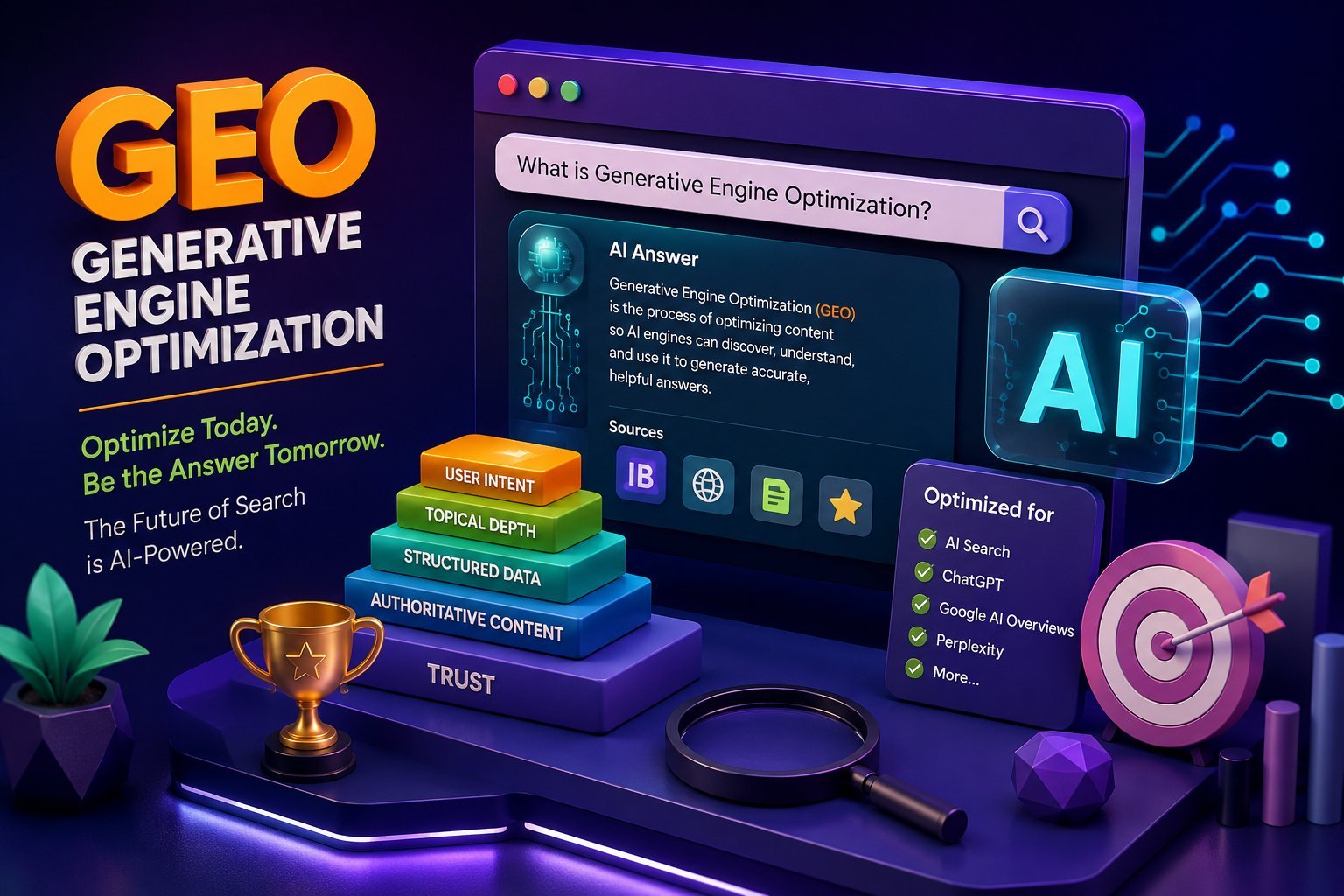
Generative Engine Optimization (GEO) is the process of optimizing content so that AI-powered search engines and generative AI platforms can discover, understand, trust, and cite it when generating responses to user queries. Unlike traditional SEO, which focuses primarily on improving rankings in search results, GEO focuses on increasing the likelihood that AI systems will use your content as a source when creating answers. When someone asks an AI assistant a question such as “What are the best ways to improve website speed?” the system may analyze information from multiple sources before generating a response. GEO helps ensure that your content is among the sources considered reliable and valuable enough to be included. The ultimate goal of GEO is not merely to earn clicks but to become part of the answer itself.
Why GEO Matters More Than Ever
Consumer behavior is rapidly evolving. Millions of people now use AI tools as their first source of information for research, product recommendations, travel planning, software comparisons, and educational content. Instead of typing keywords and clicking links, users are asking detailed questions in natural language. AI systems respond with summarized answers that often eliminate the need to visit multiple websites. This creates both a challenge and an opportunity. The challenge is that traditional organic traffic may decline as users receive answers directly within AI interfaces. The opportunity is that websites recognized as trustworthy sources can gain visibility through AI citations, mentions, references, and recommendations. In many cases, being cited by an AI platform may become just as valuable as ranking on the first page of search results.
GEO vs Traditional SEO
Although GEO and SEO share several similarities, they are not identical. Traditional SEO focuses on improving rankings for specific keywords. Success is measured through metrics such as rankings, impressions, clicks, and organic traffic. GEO focuses on making content understandable, authoritative, and useful for AI systems. Success is measured by AI citations, brand mentions, source attribution, visibility in AI-generated responses, and increased authority. SEO helps users find your content. GEO helps AI systems find, understand, and use your content. The most successful websites in the coming years will combine both approaches rather than choosing one over the other.
Where Does Answer Engine Optimization (AEO) Fit In?
Many marketers have encountered the term Answer Engine Optimization (AEO), particularly through educational resources from Ahrefs and other SEO platforms. AEO refers to optimizing content so that answer engines can directly provide answers to users. Traditionally, answer engines included voice assistants, featured snippets, knowledge panels, and question-answer platforms. The rise of generative AI has expanded this concept significantly. Today, many experts view GEO as the next evolution of AEO. While AEO focuses on helping systems retrieve direct answers, GEO focuses on helping generative AI create comprehensive responses using trusted sources. In practical terms, there is substantial overlap between the two concepts. Both GEO and AEO emphasize:
- Creating clear and accurate content.
- Answering user questions directly.
- Demonstrating expertise and authority.
- Structuring information logically.
- Making content easy for machines to understand.
When Ahrefs discusses AEO, many of the optimization principles also apply to GEO because modern AI search systems function as advanced answer engines. Rather than viewing them as competing concepts, it is more useful to think of GEO as a broader framework that includes many AEO best practices.
How AI Systems Choose Content Sources
One of the most important questions for marketers is how AI platforms determine which content to trust. Although each platform uses different technologies and ranking systems, several common factors appear to influence content selection. Authority plays a major role. Websites with strong reputations, industry expertise, and consistent publishing histories are more likely to be referenced. Accuracy is equally important. AI systems seek information that appears factual, consistent, and well-supported. Content structure matters because AI models can process organized information more effectively than poorly formatted pages. Topical depth also contributes to trustworthiness. Comprehensive articles that thoroughly explain a subject often outperform thin content. Brand recognition is another growing factor. Companies and websites frequently mentioned across the web tend to gain stronger visibility in AI-generated responses. Freshness can be important for rapidly changing topics such as technology, finance, healthcare, and digital marketing. The common theme is simple: AI systems prefer content that demonstrates expertise, clarity, reliability, and relevance.
How to Optimize Content for GEO
The foundation of successful GEO is creating content that genuinely helps users while being easy for AI systems to understand.
- Begin by focusing on questions rather than keywords alone. Modern users interact with AI using conversational queries. Content should naturally answer the questions people are asking.
- Use clear headings that reflect search intent. Headings such as “What Is Generative Engine Optimization?” and “How Does GEO Work?” help both users and AI systems quickly identify relevant information.
- Provide concise definitions near the beginning of important sections. AI systems often extract these explanations when generating responses.
- Support claims with practical examples, data, and real-world applications whenever possible. Detailed explanations are more likely to be viewed as authoritative.
- Write in simple, direct language. AI models generally favor content that communicates ideas clearly without unnecessary complexity.
- Build topical authority by covering related subjects in depth. Instead of publishing isolated articles, create clusters of content around broader themes.
- Regularly update important content to ensure accuracy and relevance.
- Most importantly, prioritize usefulness. Content created solely for search engines rarely performs well in AI-driven environments.
The Growing Importance of EEAT
Google’s concept of Experience, Expertise, Authoritativeness, and Trustworthiness, commonly known as EEAT, is becoming increasingly relevant for GEO. AI systems are designed to identify reliable information sources. Websites that demonstrate genuine expertise and real-world experience are more likely to be referenced. This means authors should showcase their knowledge, provide original insights, and create content based on actual experience whenever possible. Trust is becoming one of the most valuable assets in digital publishing. As AI-generated content floods the internet, authentic expertise will become a key differentiator.
How to Make Content More AI-Citable
If your goal is to increase AI citations, focus on creating content that can be easily extracted and referenced.
- Clearly answer important questions.
- Use logical content organization.
- Define industry terms.
- Provide actionable recommendations.
- Include examples and practical applications.
- Maintain factual accuracy.
- Avoid excessive promotional language.
- Keep paragraphs focused on a single idea.
When AI systems evaluate multiple sources, content that is easy to interpret often has a competitive advantage. The easier it is for AI to understand your content, the more likely it is to reference it.
Measuring GEO Success
Unlike traditional SEO, GEO does not yet have universally accepted performance metrics. However, several indicators can help measure success.
- Monitor referral traffic from AI platforms when available.
- Track brand mentions across AI-generated responses.
- Observe increases in direct traffic and branded searches.
- Watch for growth in authority-related signals such as backlinks and citations.
- Measure engagement metrics that indicate users view your content as valuable and trustworthy.
As AI search evolves, new analytics tools will likely emerge specifically for GEO measurement.
The Future of Search Is SEO Plus GEO
The debate should not be SEO versus GEO. The future belongs to businesses that combine both strategies. Traditional search engines continue to drive enormous amounts of traffic and will remain important for years to come. At the same time, AI-powered search experiences are becoming a primary way people discover information. Organizations that optimize only for rankings may miss opportunities in AI search. Organizations that ignore SEO entirely may sacrifice valuable organic traffic. The smartest approach is integration. Create content that ranks well in search engines, answers user questions effectively, demonstrates expertise, and provides information that AI systems can confidently cite. That combination positions your content for success regardless of how search evolves.
Conclusion
Generative Engine Optimization is rapidly emerging as one of the most important developments in digital marketing. As AI-powered search platforms reshape how people find information, businesses must rethink their content strategies. GEO focuses on helping AI systems discover, understand, trust, and reference your content. While traditional SEO remains essential, future visibility will increasingly depend on whether AI platforms view your website as a credible source. Answer Engine Optimization, a concept often discussed by Ahrefs and other SEO experts, shares many of the same principles and can be viewed as a foundation for modern GEO practices. The websites that succeed in the coming years will not simply chase rankings. They will create authoritative, trustworthy, and highly useful content that serves both human readers and AI systems. In the age of AI search, the goal is no longer just to be found. The goal is to become part of the answer.