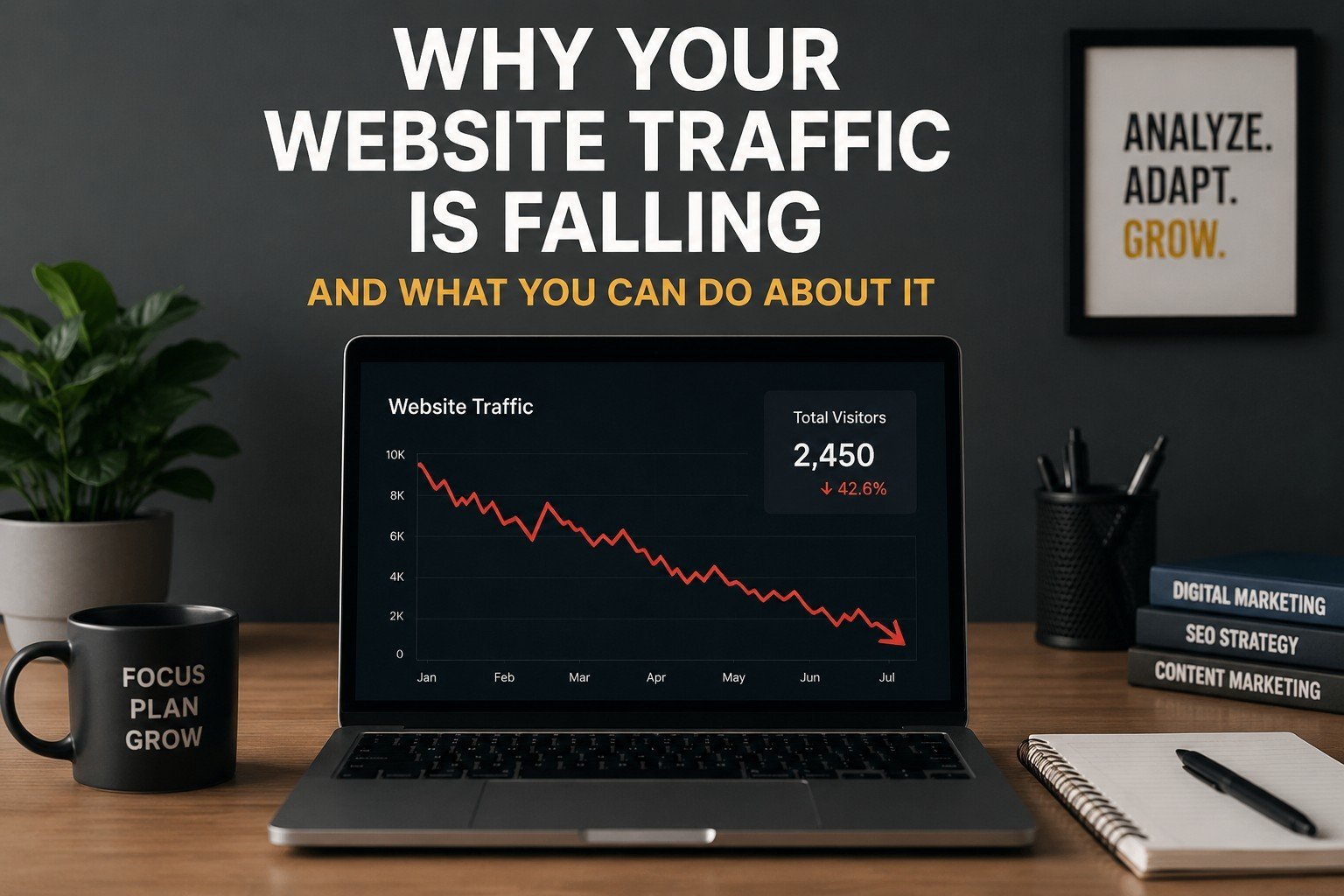
There is a particular kind of worry that every website owner knows. You open your analytics expecting to see the usual numbers, only to discover that website traffic have dropped sharply. Maybe the decline happened over several weeks. Maybe it happened almost overnight. Either way, the immediate question is usually the same: what went wrong? It is tempting to blame a Google update, a technical problem or a sudden loss of rankings. Sometimes one of those things is responsible. But in many cases, a traffic decline is the result of several smaller changes happening at the same time. Search behaviour changes, competitors improve their content, old articles become less useful, search results become more informative, and pages that once performed well gradually lose their advantage. This is why recovering organic traffic requires more than publishing a few new articles or adding keywords to existing pages. The first step is understanding what has actually changed.
A Traffic Drop Does Not Automatically Mean a Penalty
One of the most common mistakes website owners make after losing organic traffic is assuming that Google has penalised the website. That conclusion is often reached without looking closely at the data. A website can lose traffic even when it has not violated any search guidelines. A competitor may have created a more useful page. A search query may now have a different intent. Google may have changed the type of results it considers most useful. A featured result, video, discussion, map result or AI-generated answer may be taking attention away from traditional organic listings. There is another possibility that is easy to overlook. Your rankings may not have changed dramatically, but fewer people may be clicking the results.
Imagine that an article previously received 1,000 impressions and 100 clicks each month. If the same article continues to receive 1,000 impressions but now receives only 55 clicks, something has changed even though its visibility appears stable. That is why the first investigation should separate impressions, clicks, click-through rate and average position. If impressions have fallen, the website may have lost visibility for important searches. If impressions are stable but clicks are falling, search-result behaviour may be the bigger issue. If rankings have fallen for a group of related pages, the content, competition or overall authority of that topic deserves closer attention. Without making this distinction, it is very easy to spend time fixing the wrong problem.
Search Competition Has Become Much Stronger
There was a time when publishing a reasonably well-written article around a specific keyword could produce surprisingly good results. The internet has matured since then. Almost every popular subject already has hundreds or thousands of pages competing for attention. Many businesses now have dedicated content teams, professional writers, editors, researchers and established websites with years of accumulated authority. This changes the question a publisher needs to ask. Instead of asking, “What keyword should I target?” ask, “What can my article provide that existing results do not?” That difference is important.
A searcher looking for information about improving website traffic does not need another article that simply defines SEO, recommends keyword research and says that quality content is important. Those ideas are already everywhere. They need something more useful. They may want to understand why traffic disappeared after years of growth. They may want to know whether they should update old articles or create new ones. They may need help distinguishing a ranking problem from a declining click-through rate. They may want practical examples that show what to examine first. The strongest opportunity often exists inside the questions surrounding the main keyword. That is where content becomes more useful and more competitive.
The Biggest Problem With Broad Content Is Lack of Depth
Many growing websites publish articles across a very large number of subjects. This can bring variety to the website, but it can also make organic growth harder. Consider a website that publishes articles about digital marketing, travel, health, education, finance, technology, lifestyle and online business. There is nothing inherently wrong with this approach. The difficulty is that each subject requires knowledge, supporting content and credibility. A website that wants to become known for digital marketing, for example, will benefit from having several connected articles covering SEO, content strategy, keyword research, technical optimisation, internal linking, search intent, backlinks and changing search behaviour. These pages can support one another.
A visitor who arrives through one article can naturally move to another. Search engines can also understand that the website has substantial coverage of the subject. This does not mean every website must become a narrowly focused publication. It means important topics should be developed with enough depth to demonstrate genuine knowledge rather than being treated as isolated keyword opportunities.
Your Older Articles May Be More Valuable Than New Ones
When traffic declines, the instinct is often to publish more. That is understandable, but it may not be the best use of time. An older article can already have advantages that a new article does not. It may have backlinks, existing search visibility, internal links, historical engagement and recognition from search engines. If that page has declined because the information is outdated or because competitors have produced better resources, improving it may be considerably more effective than starting from scratch. Take an article published two or three years ago. The basic subject may still be relevant, but some examples may have become obsolete. Statistics may have changed. Tools mentioned in the article may no longer exist. Search behaviour may have evolved. The article may answer the original question but ignore the questions readers now ask.
An effective update should address those weaknesses. Do not simply change the publication date or add several paragraphs at the end. Read the article from the perspective of someone arriving on the page for the first time. Does it answer the main question quickly? Does it explain the subject clearly? Are there important developments missing? Does it provide enough practical information to help the reader take action? Could a competitor’s article answer the same question better? Those questions are far more useful than asking whether the page contains a certain number of keywords.
Search Intent Can Change Without You Realising It
Keywords are not permanent definitions of what people want. The meaning behind a search can change as technology, products, trends and user expectations evolve. Someone searching for “SEO tools” several years ago might have wanted a list of keyword research platforms. Today, they might expect a comparison of tools covering content analysis, technical auditing, search visibility, competitor research and AI-related features. The words have not changed much, but the expectations have.
This is one reason previously successful articles can gradually lose traffic. The page continues to target the same keyword, but it no longer satisfies the current version of the question. Before updating an article, look at the pages now appearing prominently for its main searches. Study what they cover and, more importantly, what kind of answer they are providing. You are not trying to copy them. You are trying to understand what searchers now expect so that your own article can provide a stronger answer.
Internal Links Should Help Readers, Not Just Search Engines
Internal linking is another area where many websites leave considerable value unused. A website may have dozens of relevant articles, yet each article sits alone with very few connections to the others. That wastes an opportunity. Suppose a reader arrives at an article explaining why organic traffic has declined. Once they understand the problem, they may want to learn how to improve internal linking, update old content, optimise pages for search intent or understand the growing influence of AI-powered search. If your website already contains those resources, the reader should be able to reach them naturally. This creates a useful journey through your content. The same principle works in the opposite direction. Older articles should link to newer, stronger resources where appropriate. Over time, this creates a network of related information rather than a collection of disconnected posts. The quality of those connections matters more than the number of links. A link should exist because it gives the reader something useful to explore next.
Search Results Are Becoming More Competitive for Attention
There is another reason traffic can decline even when your rankings do not collapse. The search results page itself has changed. Users may now encounter featured answers, videos, shopping results, discussions, local information, images and AI-generated summaries before they reach traditional website listings. This means being visible is not always enough. Your result needs to give the searcher a reason to visit. That makes the title and description important, but the answer should not be to write sensational headlines that promise something the article does not deliver. A strong title should accurately communicate the value of the page. If the article contains original research, practical examples or a detailed solution, make that clear. If it addresses a specific problem, say so directly. The objective is not to attract every possible click. It is to attract the right click from someone who genuinely needs what the article provides.
AI Search Makes Original Information More Valuable
The growing use of AI in search has created another challenge for publishers. Basic information is increasingly easy to obtain without visiting several websites. A person can ask a question and receive a concise explanation within seconds. That changes the value of ordinary informational content. If an article simply repeats facts that can be found everywhere, there may be little reason for a reader to visit it. Original information becomes much more valuable. This could come from an experiment, a detailed case study, a comparison, first-hand experience, original research, screenshots, analysis of real results or a perspective that is specific to a particular audience.
For example, an article about recovering website traffic becomes more useful when it explains what a publisher should examine after seeing a real decline, rather than simply saying that they should improve their SEO. The lesson is simple. Information is widely available. Useful interpretation is harder to find.
Do Not Try to Fix Everything at Once
A major traffic decline can create panic. Website owners often respond by changing titles across hundreds of pages, deleting old articles, publishing large amounts of new content, changing URLs and making technical adjustments simultaneously. That makes it difficult to understand what actually worked. A better approach is to work methodically. Start by identifying the pages that lost the most traffic. Group them by subject. Look for patterns. If most declining pages belong to one category, investigate that category first. If only older articles have declined, review content freshness and search intent. If pages are receiving impressions but fewer clicks, examine how the search results have changed. If important pages have disappeared from search altogether, investigate indexing and technical issues. The goal is to find the pattern before making major changes. A traffic report is not simply a performance score. It is evidence that can tell you where the problem is occurring.
Quality Matters More Than Publishing Frequency
There is enormous pressure on website owners to publish constantly. Every week there is another keyword to target, another trend to cover and another content calendar to complete. But publishing more does not automatically create more organic traffic. If ten new articles are thin, repetitive or aimed at topics where the website has little authority, they may add very little value. One excellent article can be more valuable than ten ordinary ones. This is particularly true when the article becomes part of a larger subject cluster and receives meaningful internal links from related pages. A good publishing strategy should therefore consider both quality and relationships. Before publishing a new article, think about what existing page it strengthens and what future articles could naturally connect to it. That approach creates a website that becomes more valuable over time instead of simply becoming larger.
Recovering Organic Traffic Requires a Different Mindset
The most useful change a website owner can make after losing traffic is to stop thinking of SEO as a collection of tricks. Search visibility is influenced by many things, including technical accessibility, content quality, relevance, competition, authority, user behaviour and how search results themselves evolve. There is no single adjustment that permanently protects a website from change. Instead, a strong website is one that can adapt. It keeps important information current. It develops depth around subjects worth owning. It understands what readers are actually trying to accomplish. It connects related resources together. It adds original insight rather than repeating information that already exists everywhere. Most importantly, it treats traffic data as a source of information rather than a reason to panic.
What Blogs Should Focus on Next
For Indian Blogs, the traffic decline should be treated as an opportunity to strengthen the website rather than simply increase the number of articles published. The existing articles should also be reviewed for overlap. When two pages answer almost the same question, keeping both pages equally focused may divide their potential. In some cases, combining them into one substantially better resource can create a stronger result. In other cases, the pages should be given clearly different purposes and linked together. The same review should be applied to older articles in other categories. Look for pages that once attracted visitors but have gradually declined. Look for articles that contain outdated information. Find pages that receive impressions but few clicks. Identify subjects where several articles already exist but are not connected through internal links. Those pages represent opportunities.
Organic Traffic Recovery Is a Process, Not a Single Fix
A decline in traffic can be discouraging, particularly when a website has been growing for a long time. But falling numbers do not necessarily mean that the website has reached the end of its growth. Search is constantly changing, and websites need to change with it. The most sustainable response is not to chase every algorithm update or publish articles simply because a keyword has search volume. It is to understand what readers need, identify where existing content is falling short and improve the pages that have the greatest opportunity. Some pages may need a serious update. Some may need stronger internal links. Some may need to be combined. Others may no longer deserve attention. New articles still have an important role, but they should support a clear subject strategy rather than fill a publishing calendar. When you approach organic traffic this way, a decline becomes useful information. It shows you where the website is losing relevance, where competitors are doing better and where readers’ expectations have changed. That is ultimately what makes a website stronger. The goal is not simply to get back the visitors that were lost. The goal is to build a website that has a better reason to be visited tomorrow than it had yesterday.