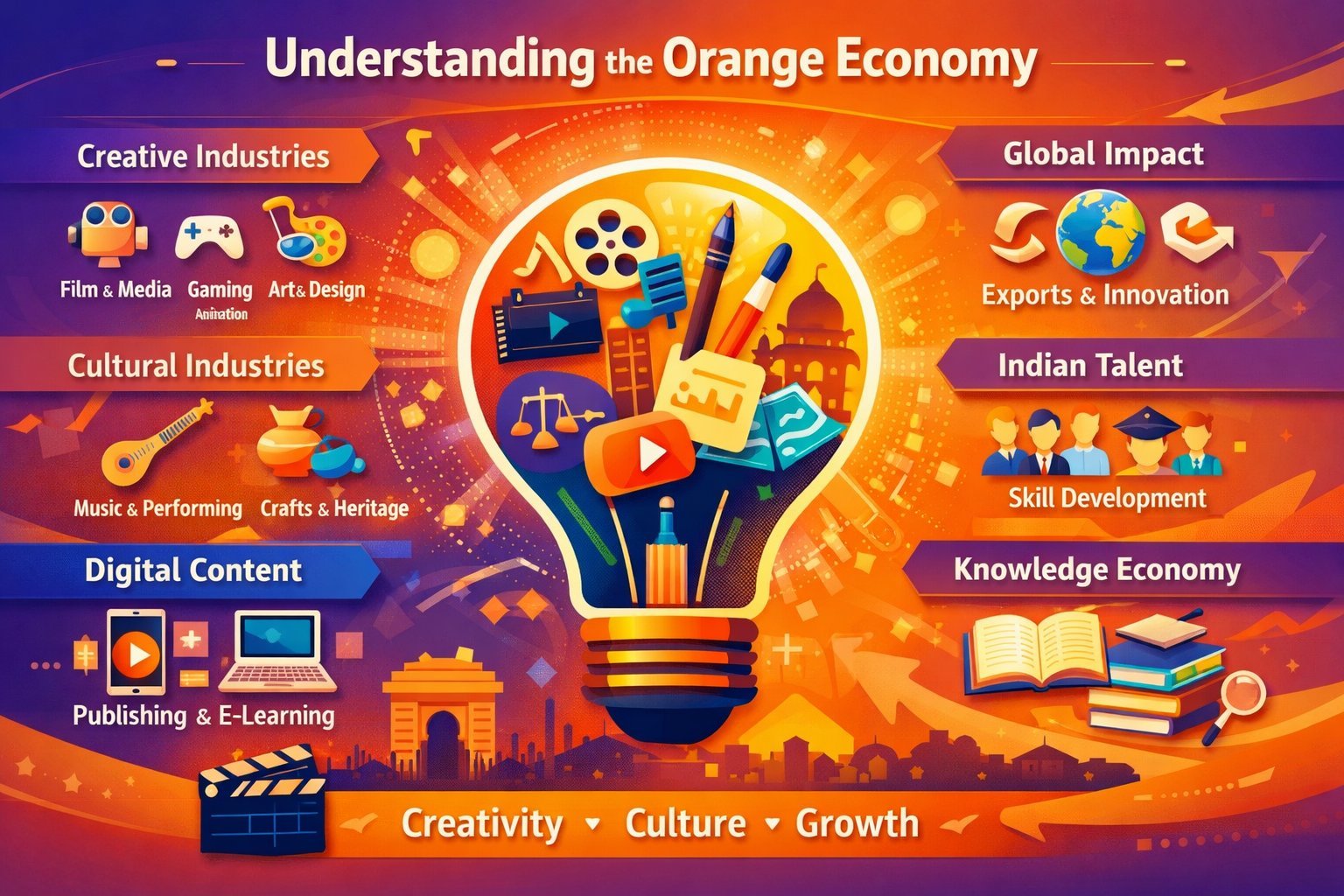
The orange economy refers to the part of the economy that is driven by creativity, culture, knowledge, and intellectual property. In simple words, it is the economy where ideas, art, and talent are the main resources instead of factories, machines, or raw materials. The term orange economy comes from the colour orange, which is often associated with creativity, imagination, culture, and innovation. This concept highlights how human creativity can generate income, jobs, and economic growth while also preserving cultural identity.
Understanding the Orange Economy
During the presentation of the Union Budget 2026-27 on February 1, 2026, Finance Minister Smt Nirmala Sitharaman introduced a term that immediately caught attention across policy circles, media, and creative industries. The phrase was the Orange Economy, used for the first time in an official Indian budget speech. Its inclusion marked a shift in how economic value is being defined in a fast changing global environment.
The orange economy refers to economic activities that are driven by creativity, culture, ideas, and intellectual property. Unlike traditional sectors that depend on physical production, this part of the economy grows through imagination, skills, and human expression. Music, films, animation, gaming, design, digital content, publishing, fashion, and cultural enterprises all fall within this space. By naming and recognising this sector, India has signalled that creativity is no longer seen as a side activity but as a serious contributor to national growth.
The Global Perspective on the Orange Economy
Across the world, the creative economy has already become an important pillar of development. Many countries have been investing in cultural industries, digital media, and creative education for years. These sectors generate employment, encourage innovation, and help nations build soft power through culture and storytelling. The strength of the orange economy lies in its ability to grow without heavy dependence on natural resources. A song, a game, a film, or a digital design can be created once and shared globally, creating long term value through intellectual property. This makes the creative economy especially relevant in the digital age, where content travels instantly across borders.
Globally, creative industries have also shown resilience. Even during economic slowdowns, demand for entertainment, digital experiences, and cultural content remains strong. This has encouraged governments to treat creativity as an economic asset rather than only a cultural one.
Why India Chose to Highlight the Orange Economy
India already has one of the richest creative ecosystems in the world. From cinema and music to traditional crafts and digital storytelling, Indian creativity reaches audiences far beyond its borders. The rapid growth of streaming platforms, online gaming, animation, and social media has further expanded opportunities for creators.
In the Union Budget 2026-27, the focus on the orange economy reflects India’s recognition of this potential. Special attention was given to sectors such as animation, visual effects, gaming, and comics, areas where global demand is rising and young talent is abundant. By supporting skill development, creative institutions, and digital infrastructure, the government aims to prepare millions of young Indians for future oriented jobs. This approach also aligns with India’s demographic reality. A young population with access to technology can turn creativity into livelihoods if the right ecosystem exists. The orange economy offers exactly that possibility.
Economic Value Beyond Numbers
The orange economy is not only about revenue and employment. It also plays a key role in preserving cultural identity. Traditional art forms, local storytelling, regional music, and indigenous crafts gain new life when connected to modern markets and platforms. This allows culture to survive, evolve, and generate income at the same time. For India, this balance is especially important. Economic growth that includes culture helps ensure that development does not come at the cost of heritage. When creativity is valued economically, artists and creators are encouraged to innovate while staying rooted in tradition.
Scholarly publishing fits naturally within the idea of economic value beyond numbers in the orange economy. By recognising and supporting ethical publishers with international reach, the orange economy expands beyond arts and entertainment into research, learning, and long-term national capacity building.
A New Direction for Economic Thinking
By introducing the term orange economy in the national budget, India has taken a symbolic yet meaningful step. It reflects a broader understanding that future economies will not be built only through factories, roads, or machines, but also through ideas, stories, visuals, and digital experiences. As global competition intensifies, countries that invest in creativity, protect intellectual property, and nurture talent are likely to gain an advantage. India’s recognition of the orange economy places it within this global shift. The coming years will show how policies, education systems, and industry support shape this vision. But one thing is clear. With the orange economy entering official economic vocabulary, creativity has claimed its place at the centre of India’s growth story.